Participant retention: seven practices for a martial arts school
Welcoming new participants, making progress visible, discussing absences and enabling a return. Seven practices and a way to measure your own outcome without promised percentage gains.
Keeping participants starts with good classes and understanding whether the offer still meets their needs. Attendance records and messages can help reveal a problem, but they do not replace a conversation. These seven practices can be introduced and assessed in your own club without treating them as a guarantee of a particular retention rate.
1. Plan how a new participant joins
Before the first class, provide the venue, time, clothing requirements and contact details. The instructor should know who is attending for the first time and how to include them. Afterwards, ask the participant or guardian what was clear and what needs explaining.
Assign responsibility for the next contact. An application reminder can help keep an appointment; it does not constitute a personal conversation with the coach. The first weeks are a useful time to check fit, but they do not irreversibly determine the whole future relationship.
2. Make progress specific
Agree small goals appropriate to age, activity and programme. They might include a particular technique, preparing independently for class or attending regularly. Explain what has been achieved and what comes next instead of promising a belt by a particular date.
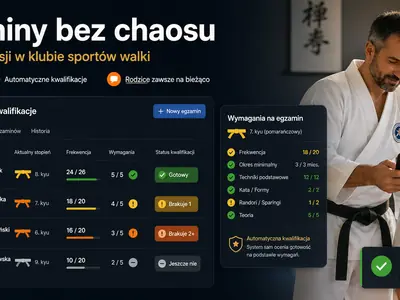
A short skills review need not be a federation exam. Separate feedback, instructor assessment and formal rank awards. In Klubownik, recorded ranks and history help review progression; indicators depend on data and configuration. The application does not independently assess the quality of a performed technique.
3. Help people build relationships in the group
Introduce new participants, establish welcoming training rules and give guardians a chance to ask questions. Family sessions or a short meeting can be offered without making them a condition of belonging. Not every parent has time for extra events.
Participation should meet the child's and family's needs. Community building does not justify pressure to stay, publishing images without appropriate arrangements or sharing contact details with the entire group.
4. Understand absences and departures
First check whether attendance has been recorded and a break is planned. A missing training record can mean missing data, illness, travel or a timetable change. An alert alone does not identify the reason or predict departure.
If someone wants to leave, offer a conversation and respect a refusal. Record only necessary information and agreed actions. Another group, time or plan may help if it actually fits. A safeguarding concern requires an appropriate response, rather than being handled solely as a customer-retention issue.
5. Prepare a move to another group
Explain in advance why you suggest the move, who will teach and the class level. Agree the first session and how you will check whether the transition worked. Introducing the new instructor is more concrete than merely moving a profile in software.
A ceremony, photograph or certificate can be an optional addition. We do not attribute unmeasured retention percentage points to them. Record actual attendance after the move and request feedback instead of assuming one ritual works for every group.
6. Match communication to the need
Separate an urgent schedule change, a payment notice and a progress conversation. Give a specific purpose and next step. Set frequency according to importance and recipient preferences; one interval is not appropriate for every family and situation.
Base a progress update on checked attendance and the instructor's assessment. A sample message: “We have been working on the stated technique; the next goal is the described exercise. Please contact the instructor if you would like to discuss participation.” Add actual facts concerning the authorised recipient.
7. Make returning clear, without default promises
For someone returning, confirm current level, available classes, prices and required participant details. Do not assume their former group still has space or that an old discount remains valid. Use the appropriate contact channel and conditions when inviting people back.
If you offer a promotion, define recipients, dates and terms before announcing it. Klubownik does not guarantee a default COMEBACK30 code or recovery of a specified percentage of former participants. A discount is the club's choice, rather than a substitute for addressing the reason they left.
Measure your own club's outcome
Choose a starting cohort, a start date and an observation date. Define what counts as staying and how breaks, transfers and returns are treated. A September group observed in June describes a season, rather than automatically representing twelve full months. Do not mix later new enrolments into the original cohort.
A calculation example: of twenty people who joined in a selected month, fifteen meet your defined staying criterion after ninety days. That cohort's result is 75%. These figures are invented for the calculation, rather than results from the author's school or an industry benchmark. Report cohort size, period and treatment of breaks alongside the percentage.
Choose one change, record its date and compare similar groups while considering seasonality and offer changes. An improved indicator alone does not prove that a message or discount caused it. The author has run a club for ten years; this guide does not present an undocumented case study of its outcomes.
Attendance review and contact with absent members help organise actions. Explore the parent portal too. Communication conditions and selected rules require setup; the demo requires an email address and an activity type.